
Marion County Court Records After a Jail Arrest
The arrest-to-court pathway in Marion County moves through several offices. The Marion County Detention Center receives the person and creates the booking record. A magistrate or municipal court judge handles bond for most people in custody. The Twelfth Judicial Circuit Solicitor, not the jail, prosecutes General Sessions criminal charges. The Clerk of Court maintains Circuit Court criminal case records, while the Magistrates Office handles lower-court criminal and traffic matters, preliminary functions, bond papers, and bench-warrant issues.
That distinction matters because court records after an arrest are not the same as jail inmate records. Jail records show custody, booking charges, bond data, holds, and release processing. Court records show the filed charge, court type, case number, hearing history, warrant consequences, disposition, and whether the charge was amended, reduced, dismissed, indicted, or resolved. Booking photos and photo-request issues belong with jail roster mugshots, not the court index.
How to Find Marion County Court Records After an Arrest
The main online court-search path is the Marion County Public Index. Start with the defendant's name, case number if one appears on the bond paper, and an approximate arrest or filing date. New filings may lag behind jail booking, and some municipal or summary-court matters may route differently, so a no-result search does not always mean no court record exists.
- Use the jail booking information to collect name, arrest date, booking date, charge wording, arresting agency, and any bond paper, warrant, ticket, or case reference.
- Search the Marion County Public Index by defendant name, case number, or filing-date range.
- Open matching entries and read the charge list, court type, case number, hearing events, bond information, and disposition fields.
- For felony or higher-level criminal charges, look for General Sessions or Circuit Court entries connected to the Solicitor and Clerk of Court.
- If the online index is not enough, contact the Clerk of Court for Circuit Court records or the Magistrates Office for bond, traffic, lower-court criminal, and bench-warrant questions.
The official Marion County Public Index screenshot shows the court-search page used for case lookup after arrest.
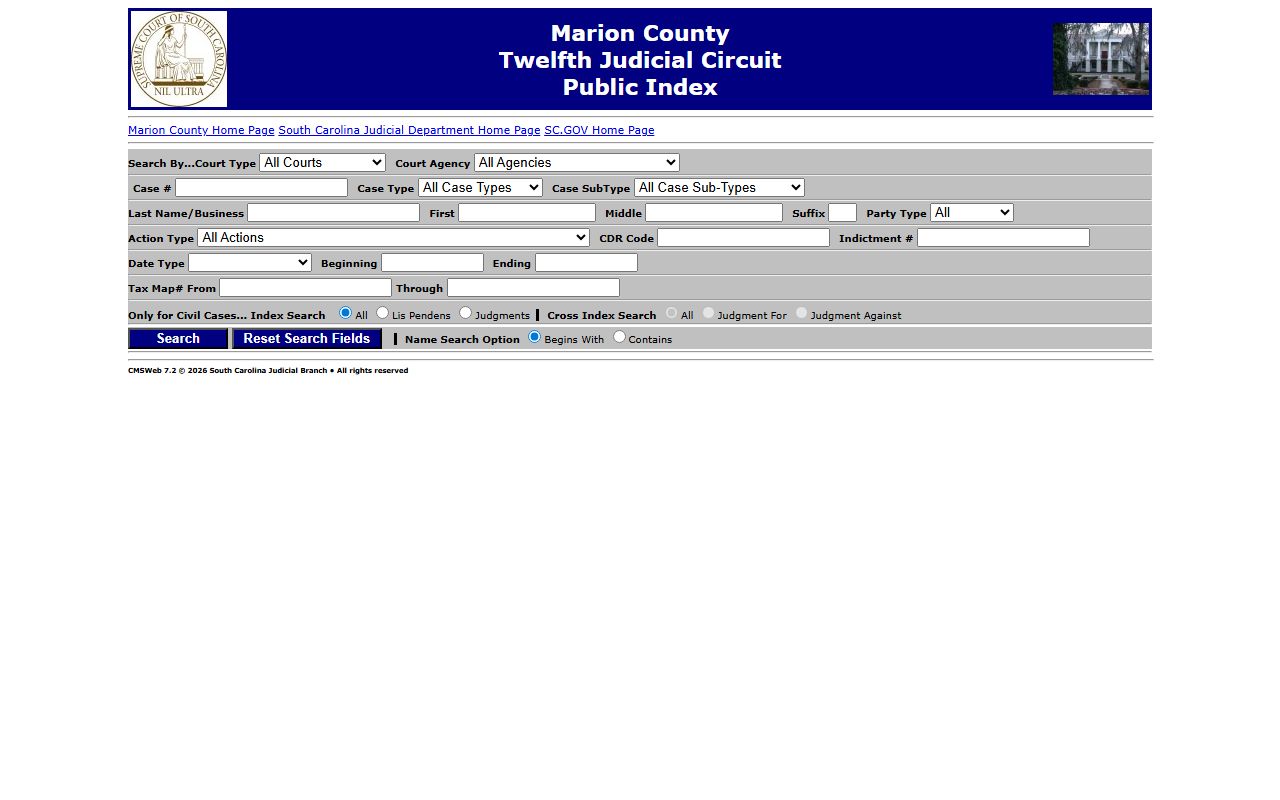
The Public Index is a case lookup tool. It can point to charges and docket events, but full copies may still require a clerk request or office visit.
Public Index Search Fields for Court Records After Arrest
Use the Public Index search fields conservatively. A case number is best when available from a bond paper, ticket, warrant, or court notice. If only a name is known, combine the name with a date range to reduce unrelated matches.
| Field Label | Type | Required | Options / Format Notes |
|---|---|---|---|
| County / path | Portal path or selector | Yes by site | Use the Marion County Public Index URL. |
| Case Number | Text | Optional | Best if known from bond paper, warrant, ticket, or court notice. |
| Last Name | Text | Optional | Defendant or litigant name search. |
| First Name | Text | Optional | Helps narrow common last names. |
| Middle Name | Text | Optional | Use if known from booking or court paperwork. |
| Date range / filing date | Date fields where available | Optional | Useful for recent arrests or common names. |
| Court type | Dropdown or filter where available | Optional | May include Circuit/General Sessions, Common Pleas, Magistrate, or Summary Court options. |
| Search / Reset | Buttons | Not applicable | Search returns index entries; full documents may require a clerk request. |
Charging Documents After an Arrest: Complaint, Warrant, Ticket, and Indictment
In South Carolina local practice, the charging paper depends on the court and offense stage. A complaint, warrant, ticket, or lower-court charging paper may start a magistrate or summary-court matter. General Sessions felony prosecution commonly moves through the Solicitor and may involve an indictment. The term information can describe a prosecutor-filed charging document generally, but it should not be treated as the ordinary Marion County term unless the specific court record uses it.
| Document | Who Uses It | Common Role | Where to Check |
|---|---|---|---|
| Complaint | Officer, complainant, or court process | Sets out the accusation that supports lower-court action. | Magistrate or summary-court records. |
| Warrant | Magistrate or judge | Authorizes arrest or reflects a failure-to-appear bench warrant. | Magistrates Office, Public Index, sheriff warrant channels. |
| Ticket / lower-court charging paper | Law enforcement or summary court | Used for traffic or lower-level criminal matters. | Magistrate or municipal court channels. |
| Indictment | Grand jury and Solicitor in General Sessions | Formal charging document for many higher-level criminal cases. | Clerk of Court and General Sessions entries. |
| Information | General prosecutor-filed concept | Use only if the specific record uses that label. | Clerk or Solicitor records if applicable. |
Charge Status in Marion County Court Records After Arrest
Charges can change as a case moves from jail booking to court. The booking charge is the arrest-side description at intake. The Solicitor or court record may later show a different charge, a changed level, an indictment, a dismissal, or a final disposition. Always read the current court status rather than assuming the initial booking charge is the final case result.
| Status | What It Means |
|---|---|
| Pending | The charge or case is still open and has not reached final disposition. |
| Amended | The charge wording, code, level, or count has changed by prosecutor or court action. |
| Reduced | The charge has been lowered to a lesser offense or lower severity. |
| Dismissed | The charge has ended by court or prosecutor action without a conviction on that count. |
| Nolle prosequi | The prosecutor declines to pursue that charge. |
| Disposition | The final outcome recorded by the court. |
| Conviction | A guilty plea, verdict, or court finding. It is not the same as an arrest. |
| Bench warrant | A warrant issued after failure to appear, failure to post bond, or failure to comply with a court order. |
Bond and Release After a Marion County Arrest
Marion County's booking, release, FAQ, and magistrate pages describe the local bond workflow. Bond hearings for county and state prisoners normally occur at 9:00 a.m. and 3:00 p.m. on weekdays, with weekend and holiday bond court at 9:00 a.m. Most prisoners typically must have a bond hearing within 24 hours of incarceration, although victim attendance, court availability, or missing paperwork can affect timing.
| Bond Type | How It Works in Local Records |
|---|---|
| Cash bond | Money paid to the court; the Magistrate prepares release documents after payment. |
| Surety bond | Bond backed by a bondsman or surety; the Detention Center will not recommend a specific bondsman. |
| 10 percent bond | Marion County FAQ says this type is posted with the court. |
| Real property | Real property may be accepted as collateral in some surety situations. |
| Fine payment / traffic cash fine | If a charge carries a cash fine, release may occur after payment to the Magistrate's Office. |
| No-bond / hold | Release is blocked because bond has not been set, a hold applies, a detainer exists, or another warrant prevents release. |
South Carolina Title 17 Chapter 15 supplies the bail and recognizance framework. Local release still depends on Marion County paperwork, NCIC want checks, Magistrate Court warrant checks, victim notification, and internal release processing.
Warrants That Lead to Court Records After an Arrest
No standalone official Marion County sheriff active-warrant search was located in the reviewed pages. Use the Sheriff's Office main number, (843) 423-8216 option 2, for sheriff-handled civil process or warrant questions. Use the Magistrates Office at (843) 292-5238 for lower-court bond, criminal, traffic, and bench-warrant consequences. The Magistrates Office states that failure to appear in court or post bond in criminal cases can result in a bench warrant for arrest.
Warrants also affect release. Marion County's release process includes an NCIC criminal want inquiry and a check of the Magistrate Court computer system for outstanding warrants or charges. That means a person can pay bond on a new charge and still remain in custody because of another hold, detainer, or bench warrant.
Charges vs. Convictions in Court Records
An arrest and charge are accusations and case events, not proof that the person was convicted. A conviction requires a plea, verdict, or court finding. Public records may show both charges and convictions, so read the final disposition before describing the outcome.
| Charge | Conviction | |
|---|---|---|
| Stage | Accusation or filed count after arrest. | Final guilty plea, verdict, or finding. |
| Record source | Jail booking, warrant, ticket, Public Index, or charging document. | Court disposition, sentence, or judgment record. |
| Can change? | Yes. It may be amended, reduced, dismissed, or indicted differently. | Changes only through appeal, post-conviction relief, correction, pardon, or other lawful process. |
| Public meaning | Shows that a case or accusation existed. | Shows a proven or admitted outcome. |
Sealed vs. Expunged Arrest Records
South Carolina expungement questions after dismissal, diversion, or qualifying disposition generally point to Title 17 Chapter 22. Juvenile and family-court youth records require separate caution under Title 63 Chapter 19. A court or agency restriction can affect what appears online, what a clerk may release, and what booking records may be disclosed under FOIA.
| Sealed | Expunged | |
|---|---|---|
| Visibility | Hidden or restricted from ordinary public view by court rule or order. | Removed, destroyed, or treated as unavailable under the applicable expungement order. |
| Record holder | Court or agency may retain restricted access. | Agencies follow the expungement order and statutory process. |
| Eligibility | Depends on the record type, court order, juvenile status, or confidentiality rule. | Depends on South Carolina expungement statutes and the case result. |
| Practical step | Ask the clerk or court about the restriction. | Use the court or Solicitor's expungement process for the eligible case. |
Local Court Contacts for Arrest-Related Records
The Clerk of Court page states that the office provides administrative support for Marion County Circuit Court, including recordkeeping for court cases, collecting court-ordered money, managing juries, and helping the public access courts and records. The same office handles custody of civil, criminal, and family court documents and collects General Sessions fines and costs.
The Marion County Clerk of Court page is the local source for Clerk Christy M. Gray's court-record office and public access information.
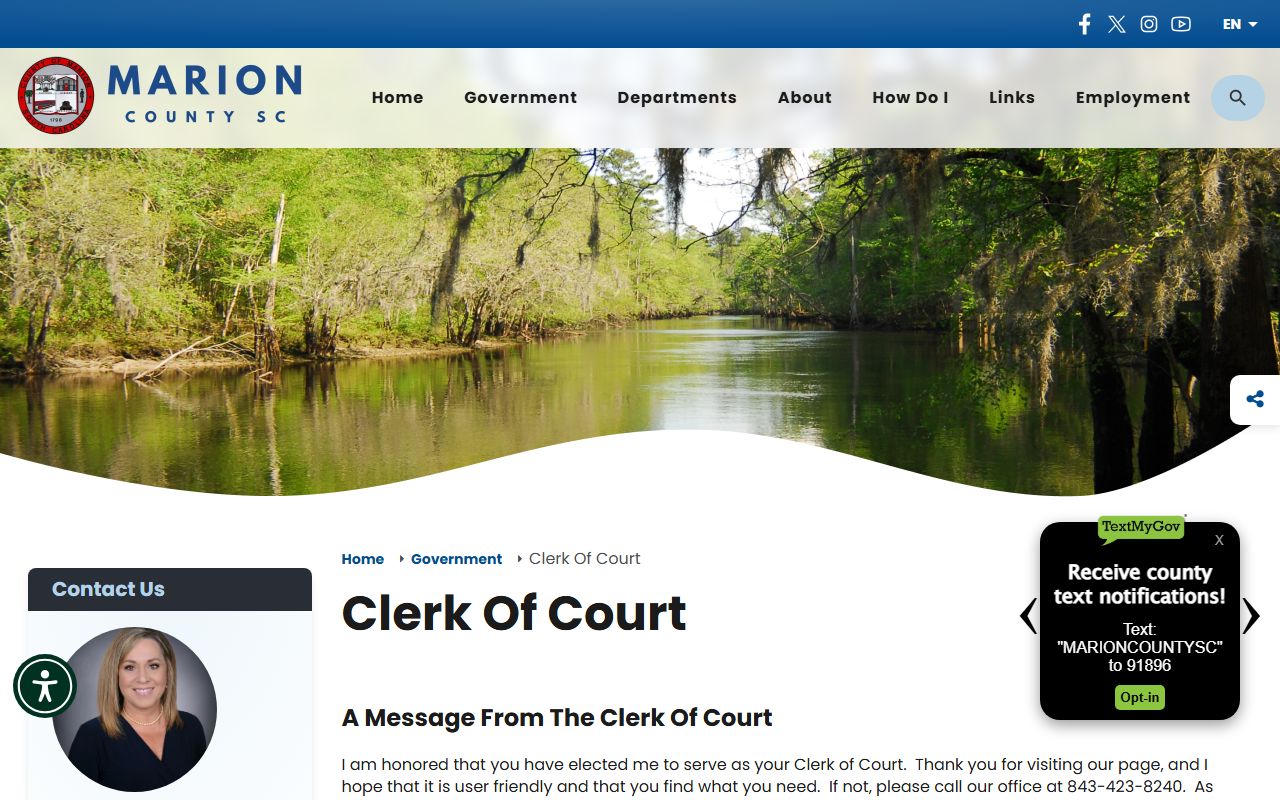
Use the Clerk for Circuit Court and General Sessions records, the Magistrates Office for bond and lower-court matters, and the Solicitor for prosecution-stage questions.
Clerk of Court
Christy M. Gray
1305 N Main Street, Marion, SC 29571
P.O. Box 295, Marion, SC 29571
(843) 423-8240
Monday-Friday, 8:30 a.m.-5:00 p.m.
Magistrates Office
Chief Magistrate K. Donald Fling
2715 East Highway 76, Suite B, Mullins, SC 29574
(843) 292-5238
Main complex: (843) 423-8216 option 3
Twelfth Judicial Circuit Solicitor
Serves Florence and Marion counties
Use for General Sessions prosecution, victim/witness, diversion, and expungement procedure questions.
Background Check Considerations
Casual court lookup and regulated background screening are different uses. A Public Index search can help identify a case, but employment, credit, housing, insurance, or tenant-screening decisions require lawful screening procedures and compliant sources. Public case data may be incomplete, delayed, restricted, or superseded by later orders.
Important: Marion County Inmate Population is not a consumer reporting agency, and its content may not be used for FCRA-covered decisions.
Restricted Court Records After an Arrest in Marion County
Some arrest-related records are not ordinary public records. Juvenile justice records have special confidentiality rules under Title 63 Chapter 19. Sealed or expunged matters may disappear from public index views or require court permission. Ongoing investigations, safety risks, medical information, victim information, and sensitive booking data can be withheld or redacted under the South Carolina FOIA framework in Title 30 Chapter 4. For lower-court criminal procedure and warrants, South Carolina Title 22 Chapter 5 is the relevant magistrate statute chapter.